
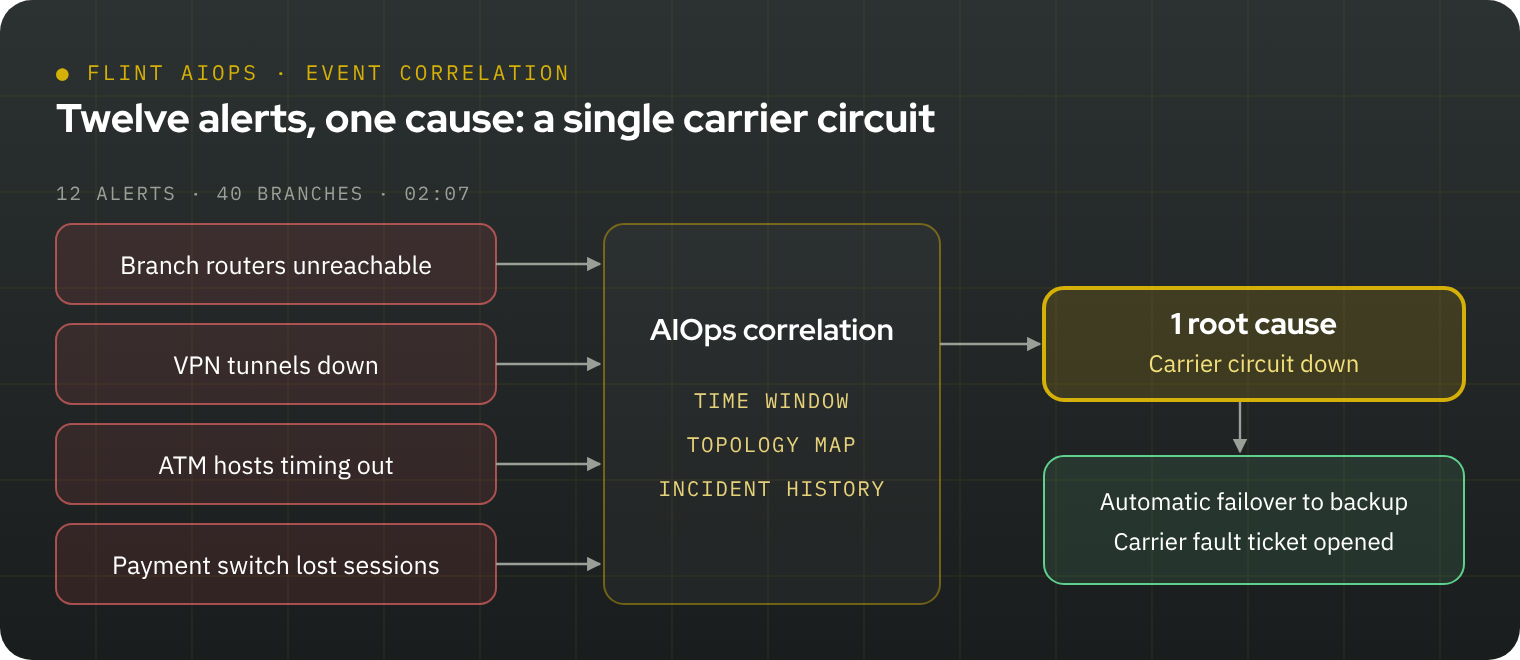
In short: Event correlation is how a network operations centre (NOC) turns an alert storm into one root cause. When 40 bank branches went dark at 2:07 a.m., Flint’s AIOps linked 12 alerts to one failed carrier circuit in seconds. Traffic failed over automatically, and the branches opened on time.
What is event correlation in a NOC?
Event correlation groups related alerts and finds the one that caused the rest. Engineers get one incident with a probable root cause, not 12 tickets.
Why does an alert storm cost banks so much?
Every minute spent chasing symptoms is a minute customers cannot pay.
- 85% of Saudi retail payments were electronic in 2025 (SAMA). ATMs and cards must work at 2 a.m.
- 57% of major outages cost over USD 100,000, and one in five top USD 1 million (Uptime Institute, 2026).
- Fibre and connectivity failures are rising and last longer, per Uptime. That is the classic branch outage.
How does AIOps find the root cause?
It checks three signals at once:
- Time: alerts firing in the same minute are related.
- Topology: every alerting branch sits behind one carrier circuit.
- History: past incidents raise or lower confidence.
Result: one root cause, one carrier ticket, minutes instead of hours.
How do you build branch failover customers never notice?
- Diverse paths: a second carrier on a separate route, not the same exchange.
- 4G/5G backup: Saudi median mobile download speed hit 216 Mbps in 2025 (CST, via GDN), enough for ATM and payment traffic.
- Automatic switchover: SD-WAN moves payment traffic first, with no one in the loop.
- Monitor and test the backup: an untested failover is a hope, not a control.
Does this support SAMA and NCA compliance?
Yes. The SAMA BCM Framework requires RTOs, a maximum acceptable outage, mapped external dependencies and annual DR testing. NCA ECC-2:2024 Domain 3 builds cybersecurity into business continuity. A topology-aware NOC supplies the dependency map, the incident timeline and the test evidence.
FAQ
What is AIOps event correlation?
AI that groups related IT alerts by time, topology and history to surface one probable root cause.
How does event correlation reduce MTTR?
It removes manual triage. Engineers start from the cause, not the alert list.
What usually causes a multi-branch bank outage?
A single upstream dependency shared by many branches, such as a carrier circuit.
Does Flint run a 24/7 NOC in Saudi Arabia?
Yes. The Flint AIOps Command Centre in Riyadh monitors networks around the clock.
Where are your single points of failure?
Sources: SAMA · Uptime Institute · CST Saudi Internet Report 2025, via GDN · SAMA BCM Framework · NCA ECC-2:2024